Is AI-assisted survey report writing compliant with RICS rules?
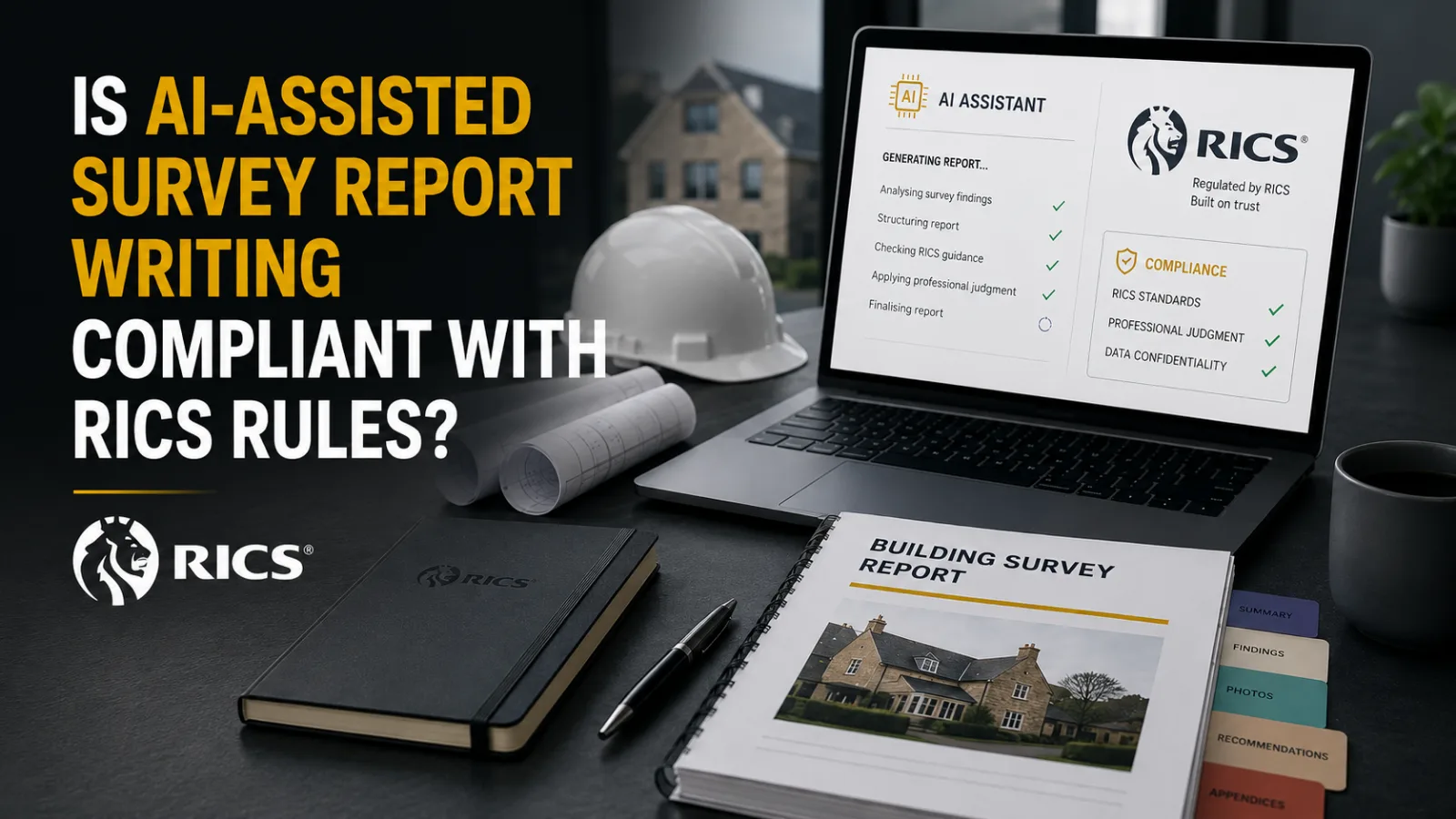
This question comes up in every conversation we have with surveyors, and it deserves a straight answer rather than a marketing one. What follows is a practical view of the issues. It is not legal advice, and you should read it alongside the current RICS Rules of Conduct and any guidance your firm's PII insurer has issued.
The regulated thing is the professional, not the software
RICS regulates members and firms. It does not certify word processors, templates, dictation software or drafting tools. Nobody asks whether your report template is compliant — they ask whether your report is.
That framing settles most of the question. A drafting tool sits in the same category as the template you already use and the dictation software many surveyors already rely on. What matters is whether the report you issue is accurate, whether it reflects your own inspection and professional judgement, and whether you take responsibility for it.
Where the real obligations bite
Four principles do the work here:
Competence — you must only report on matters you are competent to assess. A tool cannot extend your competence, and a draft that reads authoritatively on something outside your expertise is a risk, not a shortcut.
Responsibility — the report is yours. Signing a draft you have not properly read is the failure, regardless of what produced it.
Integrity and accuracy — every statement must be one you are prepared to stand behind, based on what you actually observed.
Confidentiality — client and property information is confidential, and you need to know where it is processed and stored.
The genuine risk is not the technology
The realistic failure mode is not a tool inventing a defect out of nothing. It is a surveyor reviewing a fluent, well-formatted draft less carefully than they would review their own rough prose, because it reads finished.
Polished text invites lighter scrutiny. That is a real and documented effect, and it is worth naming plainly. The mitigation is procedural: review the draft against your site notes, not against how plausible it sounds.
A draft that reads well is not the same as a draft that is right. The review is the professional work.
What you must retain
The inspection. No tool inspects the property. Every finding must originate from what you observed.
The judgement. Diagnosis, condition ratings and recommendations are yours, not a suggestion to be accepted by default.
The review. Read every line against your notes before approving. Check that nothing has been generalised into a claim you did not make.
The record. Keep your site notes and photographs. They are what evidence the report if it is ever questioned.
Do you have to tell the client?
There is no general obligation to disclose the software used to produce a report, any more than you would disclose your template or your camera. What you cannot do is misrepresent the position — implying an inspection or analysis that did not happen.
Some firms choose to mention AI-assisted drafting in their terms of engagement, framed around the surveyor retaining full responsibility. That is a reasonable, transparent position and it heads off the question before it is asked. It is a commercial and client-relationship decision rather than a regulatory requirement.
Questions worth asking any provider
Where is client and property data processed and stored, and under what jurisdiction?
Is our data used to train models?
Can we export our reports and data if we leave?
Does the workflow require explicit surveyor approval before a report can be issued?
Is there an audit trail showing who approved what, and when?
A provider that cannot answer those clearly is the risk — not the category of tool.
The short version
Using software to draft a report is not a compliance problem. Issuing a report you have not properly reviewed is — and that has always been true, whether the first draft came from a template, a dictation app, a colleague, or a model.