Damp survey reports: recording findings that stand up
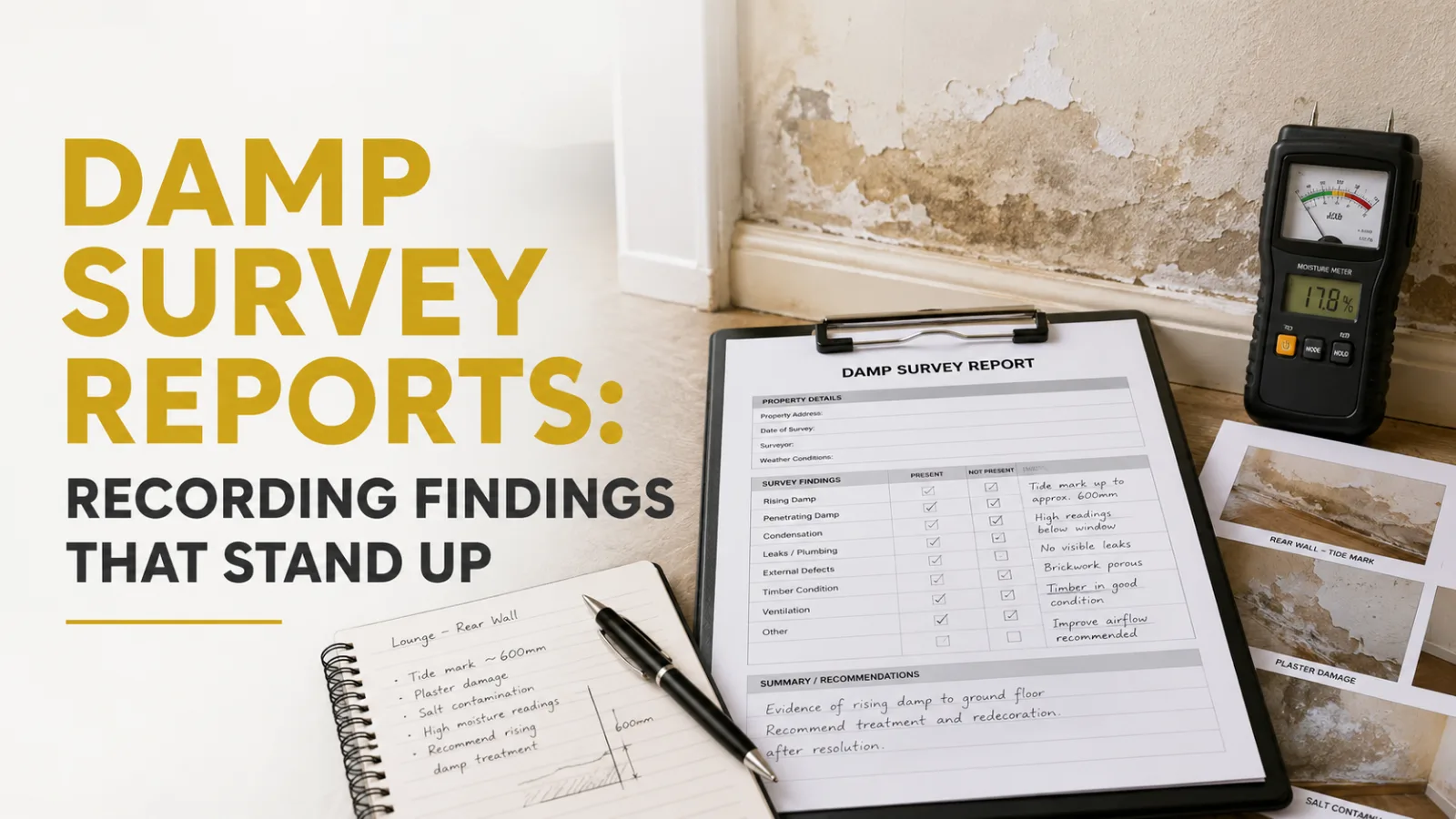
Damp generates more disputed reports than any other residential defect. Part of that is genuine diagnostic difficulty, but a large part is recording: readings without context, symptoms described as causes, and conclusions the evidence does not support.
Record the reading and the context together
A moisture meter reading on its own means very little in a report. What makes it evidential is the surrounding detail: where it was taken, at what height, on what surface, what the instrument was, and what the comparison readings were elsewhere in the property.
A reading of "high" at skirting level on one wall is not a finding. The same reading, alongside normal readings at one metre on the same wall and normal readings on the opposing internal wall, is the beginning of a pattern — and a pattern is what a diagnosis rests on.
Note the instrument type explicitly. Conductance meters on masonry respond to soluble salts as well as moisture, and a reading that is not qualified by the method invites challenge.
Distinguish the symptom from the cause
"Rising damp" is a diagnosis, not an observation. It is also the diagnosis most frequently recorded where the evidence supports something else — usually a bridged or buried damp-proof course, raised external ground levels, a failed gutter, or condensation.
The defensible structure is always the same:
Observation — what you saw and measured, in neutral terms.
Pattern — how it is distributed, and what that distribution is consistent with.
Probable cause — stated as a professional opinion, with the reasoning visible.
Uncertainty — what would confirm or rule it out.
Recommendation — what should be done, by whom, and how urgently.
The fourth point is the one most often left out, and the one that protects you most. Recording that a diagnosis is provisional pending further investigation is not weakness — it is accuracy.
The external walk matters as much as the internal
A great many internal damp findings are explained outside: ground levels above the DPC, defective rainwater goods, a blocked gully, spalled pointing, a leaking downpipe joint, or an added conservatory bridging the wall.
Record the external observations against the internal ones they explain. A report that presents internal readings in one section and external defects in another leaves the reader to make the connection. Making it for them is the value you are being paid for.
Condensation is under-diagnosed
Mould growth in corners, on cold external walls, behind furniture and around window reveals points to condensation rather than a rising or penetrating source. Recording the ventilation provision, the heating pattern, the occupancy, and the presence of trickle vents and extract fans gives that diagnosis a foundation.
Where the property is occupied, note the conditions at the time of inspection — internal temperature, whether windows were open, whether drying was taking place indoors. Those details are unavailable later and frequently decisive.
If your report cannot show why you ruled out condensation, expect the diagnosis to be challenged.
Photograph the pattern, not just the patch
A close-up of a damp patch shows a damp patch. What supports a diagnosis is the wider shot showing its position and extent relative to the floor, the DPC and the external ground level — ideally with something in frame for scale.
Take both. The detail shot for the client, the context shot for the file.
Be explicit about what you did not do
Where you did not lift floor coverings, could not access a subfloor void, or did not carry out invasive investigation, say so against the finding it affects. A limitation recorded next to the relevant observation carries far more weight than the same limitation buried in a schedule at the back.