Snagging list vs snagging survey: what's the difference?
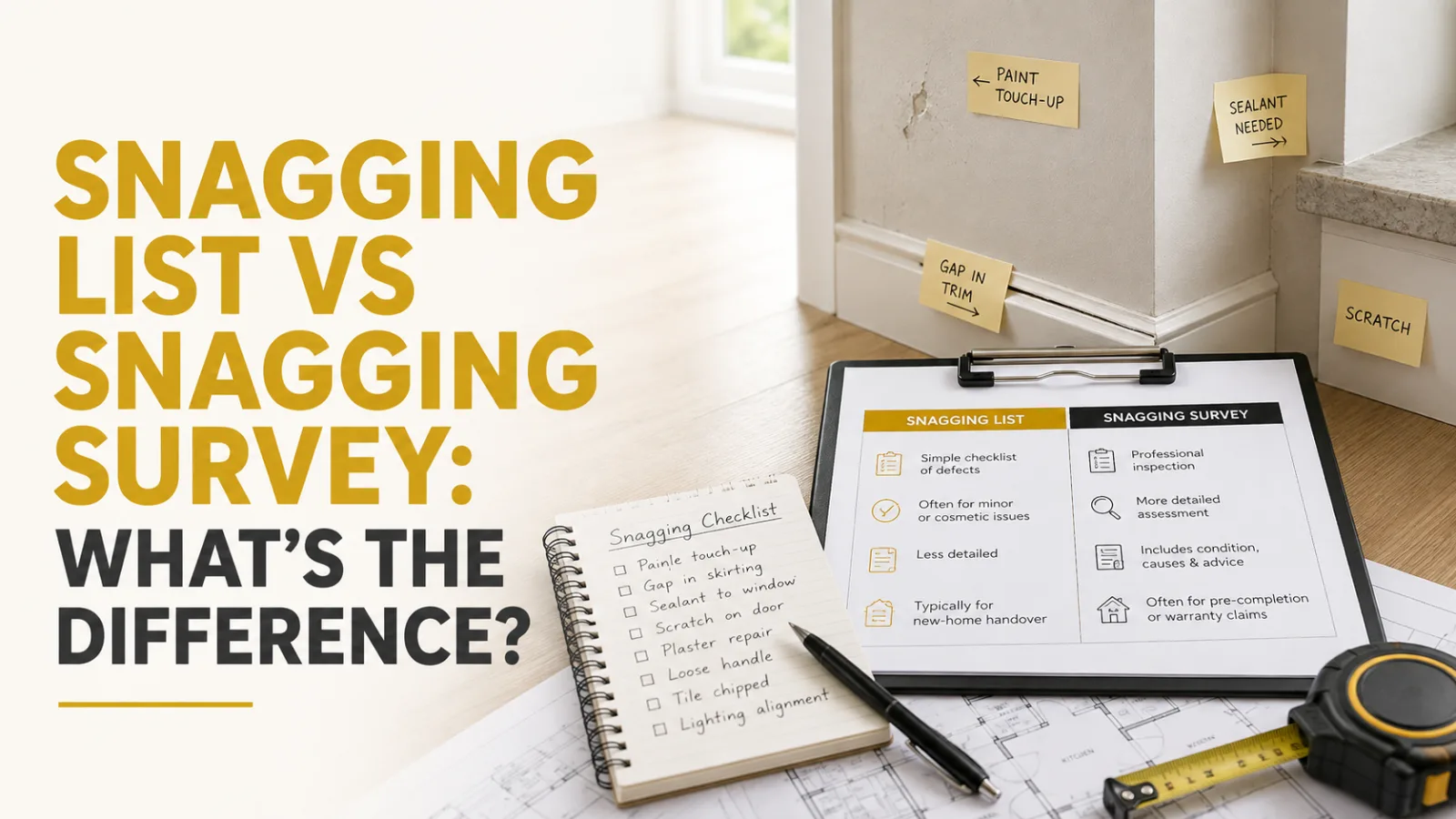
On a new-build handover, "snagging" gets used loosely for everything from a homeowner's list of paint marks to a chartered surveyor's formal inspection. The distinction is worth being precise about, because it changes what the document is worth if a defect ends up in dispute with the developer.
A snagging list is the buyer's own record
A snagging list is what a purchaser compiles themselves, usually in the first days after moving in: scuffed skirting, a door that catches, a radiator that rattles, a missed patch of sealant. It is useful, and developers expect it, but it carries no professional weight. It records what an untrained eye happened to notice.
A snagging survey is an independent professional inspection
A snagging survey is carried out by a surveyor, ideally before legal completion, and covers what a homeowner cannot reasonably assess: whether the work meets the relevant standards and the developer's own specification, not merely whether it looks finished.
The value is in the items a buyer would never spot — inadequate loft insulation depth, missing cavity trays, poorly formed weep holes, incorrect ventilation, falls on a flat roof, or external works that will not drain. These are the defects that cost real money later, and the ones a developer is obliged to put right under warranty.
What a snagging report should contain
A clear scope — what was inspected, what was not accessible, and the standard the work is assessed against.
Room-by-room and elevation-by-elevation findings, each described specifically rather than as a running list.
A severity indication for each item, separating cosmetic snags from defects that breach standards.
Photographs with enough context to locate each item.
Reference to the relevant standard where an item is a compliance failure, not just a preference.
The developer will fix what is clearly a breach of standard far more readily than what reads as a matter of taste — so the report has to make the distinction for them.
Timing is the practical point
Wherever the contract allows, the inspection is worth doing before completion, while the buyer still has leverage. After completion the defects are still the developer's responsibility under the warranty, but the process of getting them addressed is slower and the buyer is negotiating from a weaker position.
In short
A snagging list is a helpful homeowner document. A snagging survey is a professional assessment against a standard, and it is the one that holds up when a developer pushes back. If a client asks for "a snag list," it is worth clarifying which of the two they actually need.